
The Problem With Starting Over Every Monday
Most people don’t struggle because they don’t know what to do.

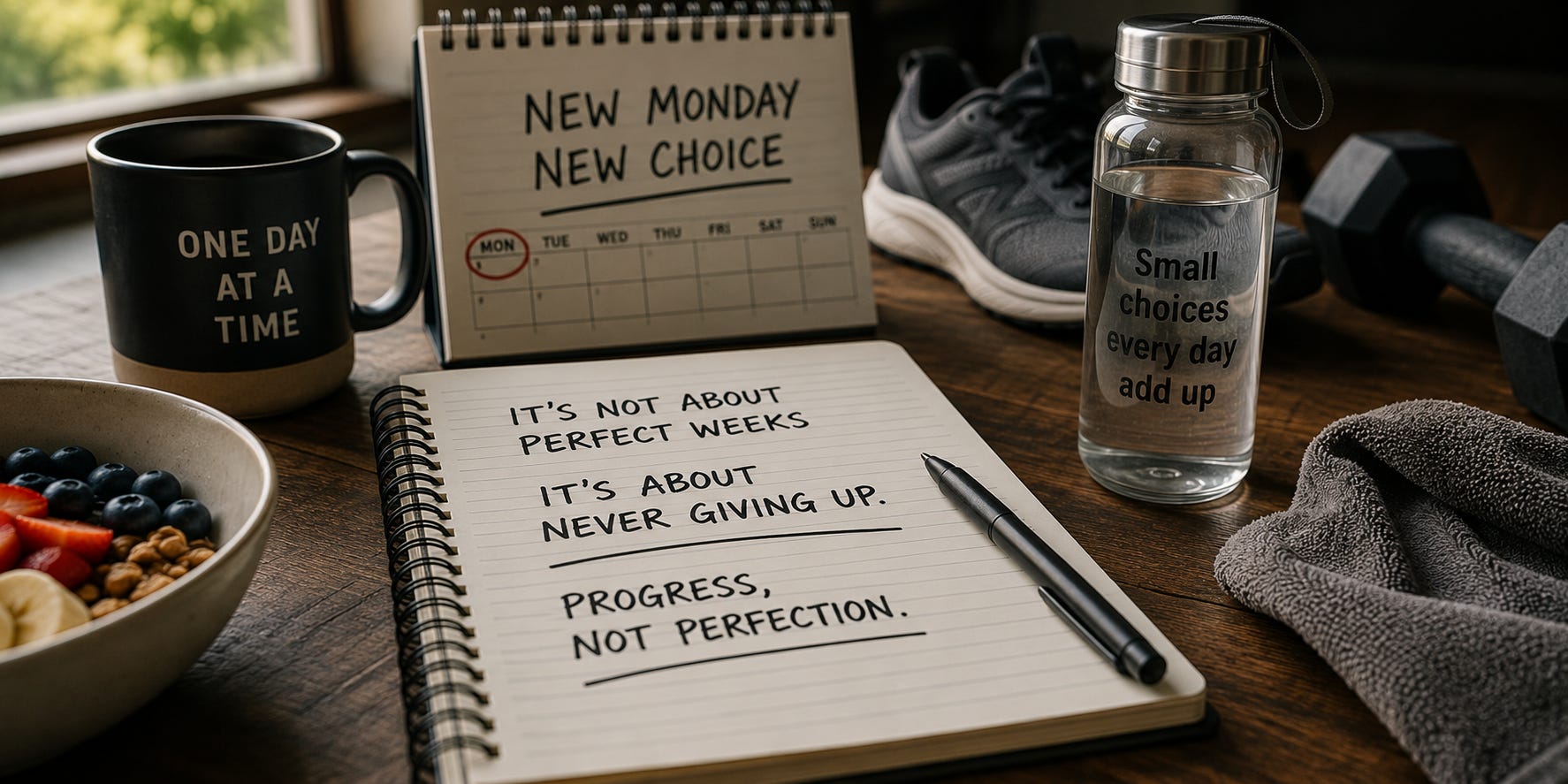
They know that moving more would benefit their health. They know that eating more nutritious foods would probably improve their energy levels. They know that drinking more water, sleeping better, and exercising regularly would have a positive impact on both their physical and mental wellbeing.
The problem isn’t usually a lack of information.
The problem is that many people find themselves trapped in a cycle of starting over.
For some, it happens every Monday. For others, it’s the first day of a new month, after a holiday, or following a period where life became particularly stressful. There is a sense of determination that this time things will be different. A fresh start feels exciting. New goals are set, plans are made, and motivation briefly returns.
Then life happens.
A stressful day leads to comfort eating. A busy week results in missed workouts. Energy levels drop. Routines are interrupted. Before long, the healthy habits begin to fade and the familiar feeling of disappointment returns.
Eventually another Monday arrives and the cycle starts all over again.
Over time, this can become exhausting. Not because of the physical effort involved in trying to get healthier, but because of the emotional burden that comes with repeatedly feeling as though you’ve failed.
Why We Treat Setbacks Like Failure
One of the biggest reasons people continually start over is because they view setbacks as evidence that they’ve failed.
Many of us have been conditioned to think in extremes. We’re either “on track” or “off track.” We’re either eating perfectly or eating badly. We’re either committed to our goals or we’ve completely given up.
The reality is rarely that black and white.
Imagine someone who exercises three times a week for six weeks and then misses a few sessions because work becomes hectic. From a logical perspective, they have still exercised consistently for most of that period. Yet many people focus entirely on the missed workouts rather than the progress they have already made.
The same thing happens with nutrition. Someone might eat well for most of the week, enjoy a takeaway meal on Saturday, and suddenly convince themselves they’ve ruined everything. By Sunday evening they’re already promising themselves they’ll start again on Monday.
The problem isn’t the takeaway.
The problem is the belief that one imperfect choice somehow erases weeks of positive behaviour.
When we think this way, every setback feels like a reason to quit.

Why Healthy People Don’t Start Over
This may sound strange, but genuinely healthy people rarely talk about starting over.
That’s because they don’t view their habits as something that exists in a constant state of success or failure.
They understand that some weeks will be better than others.
There will be holidays.
There will be stressful periods.
There will be times when exercise takes a back seat.
There will be meals that aren’t particularly healthy.
The difference is that they don’t interpret these moments as evidence that they’ve failed. Instead, they simply return to their routine as soon as they can.
This is a subtle but important distinction.
A person trapped in the start-over cycle sees a missed workout and thinks, “I’ve ruined my week.”
A person with a sustainable mindset sees a missed workout and thinks, “I’ll get back to it tomorrow.”
The event is the same. The interpretation is completely different.
Progress Is Often Messy
Social media has created an unrealistic picture of what progress looks like.
Most success stories are presented as smooth, linear journeys. Someone decides to improve their health, stays motivated, follows the plan perfectly, and achieves their goal.
Real life rarely works that way.
Real progress is messy.
It includes setbacks, periods of low motivation, busy schedules, illness, holidays, emotional struggles, and countless unexpected obstacles.
The people who succeed aren’t the people who avoid these challenges.
They’re the people who keep returning despite them.
Progress isn’t measured by how many times you fall off track.
It’s measured by how quickly you’re willing to return.
When viewed through that lens, setbacks become far less threatening.
They’re no longer signs of failure.
They’re simply part of the process.
The Power of Never Missing Twice
One of the most useful ideas in habit building is the concept of never missing twice.
Missing once is normal.
Missing twice is the beginning of a new pattern.
Everyone will occasionally skip a workout, eat more than they planned, or neglect a healthy habit for a day. The goal isn’t to avoid these moments completely, the goal is to prevent them from turning into weeks or months.
If you miss a walk today, go tomorrow. If your nutrition slips over the weekend, make a healthier choice at your next meal. If you’ve been inactive for a week, start with ten minutes rather than waiting for the perfect moment to begin again.
Small recoveries are often more powerful than dramatic restarts.
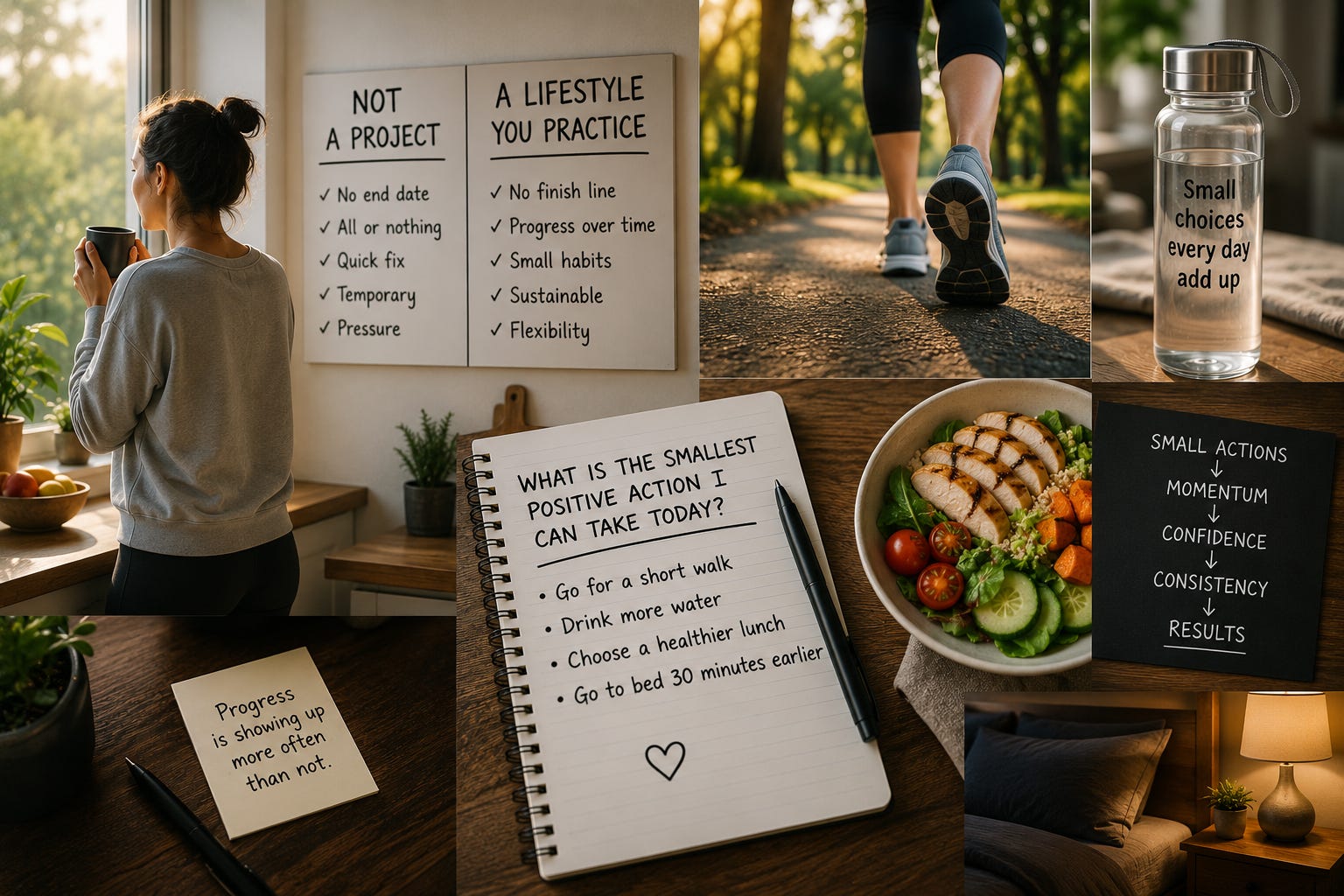
Building a Lifestyle Instead of a Project
Many people approach health as though it’s a temporary project.
They have a start date and an end date in mind. Once they achieve a certain weight, complete a challenge, or reach a particular goal, they assume the work is finished.
The problem with this approach is that health isn’t something we complete.
It’s something we practise, a sustainable lifestyle leaves room for real life.
It allows flexibility.
It accepts imperfection.
It recognises that consistency doesn’t require doing everything perfectly every day.
Instead, it focuses on showing up often enough that progress continues over time. This mindset removes a huge amount of pressure, You no longer need to have a perfect week.
You simply need to keep moving forward.
A Different Question to Ask Yourself
The next time you feel tempted to start over on Monday, pause and ask yourself a different question.
Instead of asking:
“How do I get back on track?”
Ask:
“What is the smallest positive action I can take today?”
Maybe it’s a short walk.
Maybe it’s drinking more water.
Maybe it’s choosing a healthier lunch.
Maybe it’s going to bed thirty minutes earlier.
Small actions may not feel significant in the moment, but they create momentum. Momentum builds confidence. Confidence encourages consistency. Consistency creates results.
That process is rarely exciting.
It doesn’t generate dramatic before-and-after photos overnight.
But it works.
Final Thoughts
Perhaps the biggest shift we can make is recognising that healthy living isn’t about repeatedly starting over.
It’s about continuing.
There will always be difficult days. There will always be periods where motivation fades and routines become harder to maintain. That’s normal.
What matters is not whether you stay perfectly on track, What matters is whether you keep returning. The healthiest people aren’t the people who never struggle They’re the people who refuse to let temporary setbacks become permanent ones.
So if you’ve found yourself promising to start again next Monday, maybe this week requires a different approach.
Maybe you don’t need another fresh start.
Maybe you simply need to keep going.
Looking to build more calm, clarity, control, and confidence in your life?
You can explore more through The 4C’s Method by Ian Callister
Thanks for reading,
Ian
Rise with clarity and confidence.
I am this person 🤦🏼♀️
But slowly morphing into the next version that says it's ok, start again. Which is a massive leap from "I've missed a day of veggies, now my life is over" that in fact Mondays can now be 3pm on a Tuesday or starting again in the next moment.
I want to go for a hike every week, but I'm happy to go for a walk everyday which that compounds better than waiting for my once a week hike.
Thanks Ian!