
Looking Back Before We Climb Higher
A Reflection on Series One and the Journey Ahead

From The Guided Ascent, a series within The Ascent Within
When I wrote the first article in what became The Guided Ascent, I knew the direction I wanted to travel in, but I didn’t know exactly what the journey would look like.
Looking back now, I think that’s rather appropriate.
One of the ideas that has surfaced repeatedly throughout this first series of articles is that clarity doesn’t always arrive before we begin. We often assume we need the full plan, complete certainty, or a detailed map before taking the first step. Yet life has a habit of teaching us something different. More often than not, clarity grows through movement. We learn by doing. We discover by paying attention. The path becomes clearer because we’ve had the courage to start walking.
In many ways, this publication has followed that same pattern.
It didn’t emerge fully formed. It evolved.
Originally, there were separate Practical and Deeper Ascent articles. As I continued writing, something became increasingly obvious. They weren’t really two different conversations. They were two parts of the same one. One introduced an idea in a practical, accessible way, while the other slowed down and explored it more deeply. Bringing them together into The Guided Ascent felt less like changing direction and more like allowing the publication to become what it had quietly been growing towards all along.
That has been one of the unexpected pleasures of writing this series. It has reminded me that creating something meaningful isn’t always about following a rigid plan. Sometimes it’s about listening carefully to what is emerging and being willing to refine it as you go.
Perhaps that’s true of life as well.
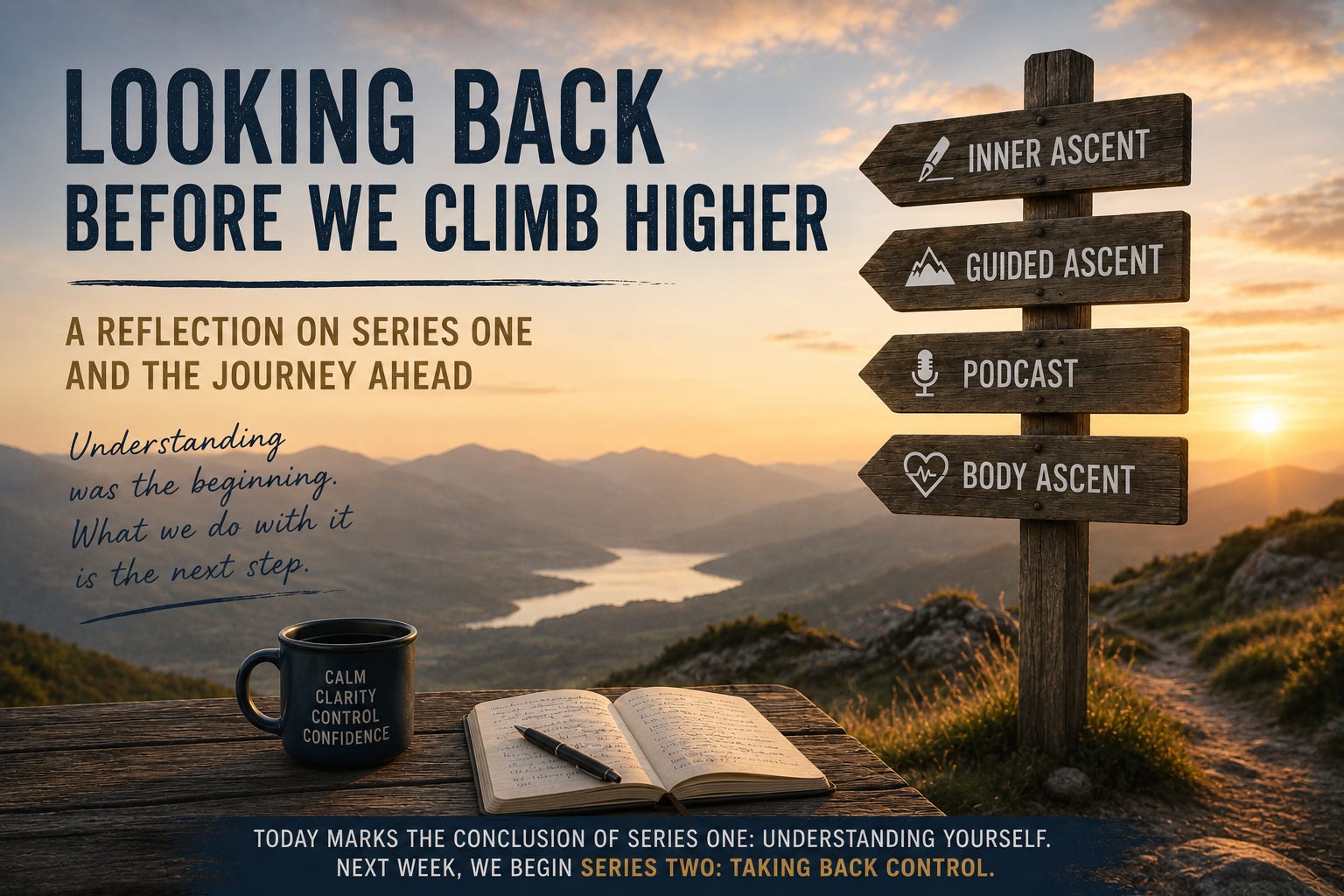
As the publication has evolved, I’ve realised that each section serves a different purpose, yet they all point towards the same destination.
The Inner Ascent is where I write most personally. Those essays often begin with an ordinary moment, a conversation, an observation or an experience that has stayed with me. They’re less about offering answers and more about exploring the questions life keeps placing in front of us. They invite reflection rather than instruction, and many of the ideas that later find their way into The Guided Ascent begin there.
The Guided Ascent has become something slightly different. It’s a slower, more structured journey through the challenges many of us face, not by offering quick fixes or simple solutions, but by taking the time to understand why our minds and behaviours work the way they do. My hope has always been that these articles feel less like lessons and more like someone walking alongside you, helping you notice things that are often difficult to see when you’re standing in the middle of them.
Alongside those, the podcast has given me another way of exploring these ideas. Sometimes a conversation allows an idea to breathe differently than the written word, and I’ve enjoyed having that space to continue the journey in another format.
(Although this is still definitely in its infancy haha)
More recently, The Body Ascent has become an important part of the publication too. The longer I spend writing about mindset, the more convinced I become that our mental wellbeing cannot be separated entirely from the way we care for our bodies. Sleep, movement, nutrition, stress and recovery all influence the way we think and feel. It seemed only right that the publication should reflect that connection.
Although these sections are different, they’re really exploring the same question from different directions.
How do we build a healthier, calmer and more meaningful life?
When I look back over the articles that have made up Series One, I don’t immediately think about anxiety, overthinking or confidence.
I think about understanding.
Everything we’ve explored has, in one way or another, been an invitation to understand ourselves a little better.
We’ve looked at how the body and mind communicate with one another. We’ve explored why our thoughts become noisy, why we sometimes feel stuck despite trying so hard to move forward, why familiar patterns keep repeating themselves, why self-trust can feel fragile and why uncertainty often seems so uncomfortable.
The final articles brought all of those ideas together in what I believe is one of the most important mindset shifts we can make: recognising that we are not our thoughts.
If there has been one thread running quietly through every article in this series, it has been this:
Understanding ourselves with curiosity is far more powerful than judging ourselves with criticism.
So much of personal development encourages us to fix ourselves as quickly as possible. It tells us to eliminate fear, silence doubt and replace negative thinking with positive thinking.
I’m not convinced that’s where lasting change begins.
Lasting change usually begins with understanding.
Because when we understand why a pattern exists, we stop seeing it as evidence that something is wrong with us. Instead, we begin to see it as something that developed for a reason, something that once made sense, and something that can gradually be reshaped.
That perspective doesn’t remove every difficulty.
But it replaces judgement with compassion.
And I think that’s a much healthier place from which to grow.
One of the things writing this series has reminded me is that growth rarely feels dramatic while we’re living it.
We tend to imagine transformation as a single breakthrough, a moment where everything suddenly makes sense and life changes overnight.
Most of the time, it isn’t like that.
It’s quieter.
You notice yourself responding differently to a situation that would once have overwhelmed you.
You catch yourself questioning a thought instead of automatically believing it.
You recover from setbacks a little more quickly.
You find yourself pausing before reacting.
None of those moments seem particularly significant on their own.
Yet when you look back after several months, you realise that something fundamental has shifted.
Real growth often looks like a collection of small changes that only become obvious when viewed together.
So before we continue climbing, I’d like to encourage you to pause for a moment.
Think back over the articles from this first season.
Which one stayed with you?
Which idea challenged the way you think?
What have you started noticing about yourself that perhaps you couldn’t see a few months ago?
You don’t need profound answers.
Sometimes the smallest observations are the ones that quietly change the direction of our lives.
Next week we’ll begin Series Two: Taking Back Control.
If Season One has been about understanding ourselves, then Season Two will ask a different question.
What do we do with that understanding?
Over the coming months we’ll explore the everyday patterns that shape so much of our lives: comparison, people pleasing, perfectionism, procrastination, boundaries, emotional reactions, habits and many of the quiet behaviours that either support or undermine our wellbeing.
Not as isolated topics, but as connected parts of the same journey.
Because awareness is a wonderful place to begin.
Eventually, though, awareness needs to become action.
That is the journey we’ll be starting together.
Before I finish, I simply want to say thank you.
Whether you’ve been reading since the first article or have joined somewhere along the way, thank you for giving your time to these reflections. In a world that often encourages us to move faster, consume more and think less deeply, it means a great deal that you’ve chosen to pause here for a while.
I hope this publication continues to be a place where you find thoughtful ideas, honest reflections and practical guidance that help you build a little more calm, a little more clarity, greater control over how you respond to life, and the quiet confidence that grows from understanding yourself more deeply.
The mountain is still there.
There are many more paths to explore.
But before we climb any higher, I think it’s worth turning around for a moment, looking at how far we’ve already come, and appreciating that every step has mattered.
I’ll see you next week as we begin the next stage of The Guided Ascent.
Looking to build more calm, clarity, control, and confidence in your life?
You can explore more through The 4C’s Method by Ian Callister
Thanks for reading,
Cally
Rise with clarity and confidence.
You have a podcast?! that's cool!!
I love that you stay with the reflection rather than the answer all nicely tied up in a bow. I've recently realized that triggers are merely spotlights on feelings and to acknowledge them in the moments rather than allow them to consume my whole day has been the biggest growth. It didn't happen over night, they never do. But once you can get yourself back to baseline quicker each time, it's so empowering.
Stay curious, Ian. Looking forward to the next series 🙏🏼