
Learning to Move Before You Feel Certain
Part 2: How to Take Action When You Can’t Guarantee the Outcome

From The Guided Ascent, a series within The Ascent Within
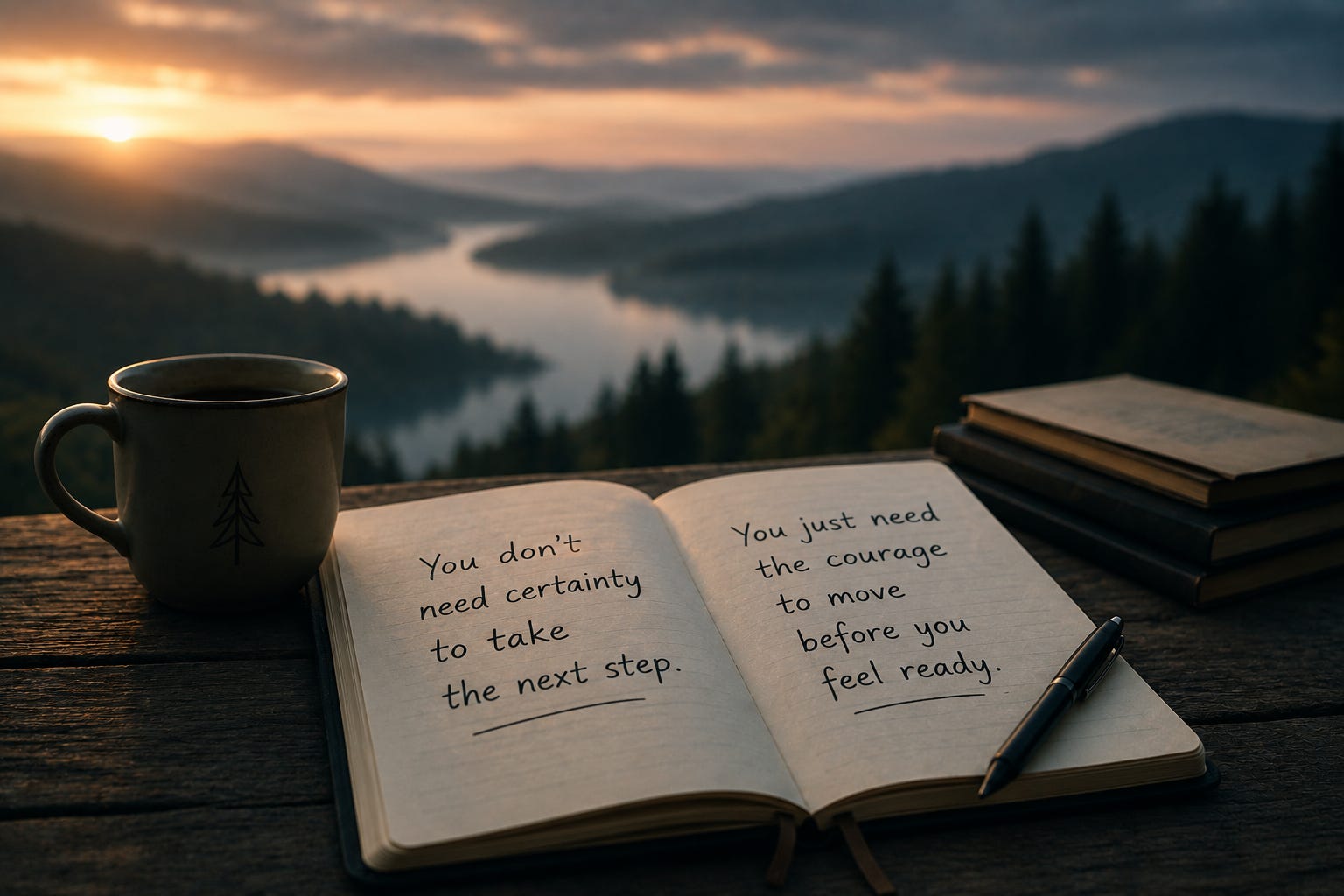
In the previous issue, we explored the fear of getting it wrong and how that fear often becomes much larger than the mistake itself. We looked at how many of us spend years trying to avoid failure, disappointment, embarrassment, or regret, often without realising that the attempt to avoid those experiences can become its own kind of limitation.
Understanding that is important.
But understanding it doesn’t automatically change it.
Most people can recognise that certainty doesn’t really exist. They know life comes with risk. They understand that mistakes are part of being human. Yet when they’re faced with a decision that genuinely matters, the same hesitation often appears. The same questions surface. The same instinct to wait a little longer, think a little more, or prepare a little further begins to take hold.
The challenge isn’t usually a lack of awareness.
It’s that there is a difference between accepting uncertainty as an idea and accepting it as an experience.
I think many of us grow up believing that confidence comes before action.
Without ever saying it directly, we absorb the idea that confident people know what they’re doing. That they feel certain before they begin. That they somehow possess a level of clarity that the rest of us haven’t yet found.
It’s an understandable assumption, but the more I’ve observed people, the less convinced I am that it’s true.
When you speak to people who have started businesses, changed careers, moved to a new place, written a book, begun a relationship, ended one, or taken any meaningful step into the unknown, a different picture tends to emerge.
Very few of them describe feeling completely certain.
Many describe feeling nervous.
Many describe feeling unprepared.
Many admit they had doubts right up until the moment they acted.
What separated them from everyone else wasn’t certainty.
It was their willingness to move despite not having it.
That distinction matters because it changes what we’re aiming for.
If certainty is the goal, we may spend years waiting.
If movement is the goal, progress becomes possible much sooner.
One of the reasons uncertainty feels so uncomfortable is that the mind naturally wants closure.
It wants to know how things will turn out. It wants reassurance that effort will be rewarded, that decisions will work out, and that risks will prove worthwhile. There is something deeply human about wanting that.
The difficulty is that life rarely provides those guarantees in advance.
Most of the experiences that shape us arrive without a detailed roadmap. They require us to step into something before we fully understand what it will become.
Looking back, this has been true of almost every significant chapter of my own life.
At the time, those chapters felt uncertain. Some felt uncomfortable. A few felt downright risky. Yet when I look back now, I can see that the clarity I wanted wasn’t available beforehand.
It emerged through experience.
The understanding came afterwards.
The confidence came afterwards.
The growth came afterwards.
And I suspect that many of the things you’re proudest of in your own life followed a similar pattern.
There is a phrase that has become increasingly important to me over the years:
Most people don’t need more certainty. They need more trust in their ability to handle uncertainty.
When I first came across that idea, it stopped me in my tracks because it shifted the focus entirely.
For years, I had assumed that confidence came from reducing uncertainty. The goal, consciously or unconsciously, was to gather enough information that doubt would finally disappear. What I eventually realised was that doubt rarely disappears completely.
Instead, confidence seems to grow when you stop demanding guarantees from the future and start recognising your own ability to respond to whatever the future brings.
That isn’t the same thing.
One approach asks life to become more predictable.
The other asks you to become more adaptable.
And adaptability is something most people already possess, even if they don’t fully appreciate it.
It’s worth pausing for a moment and reflecting on how many things you’ve already handled that once seemed overwhelming.
Think back five years.
Ten years.
Even one year.
There were probably situations that felt enormous at the time. Decisions that kept you awake at night. Problems that seemed impossible to solve. Uncertainties that felt unbearable yet somehow you found your way through them.
Not perfectly.
Not without mistakes.
Not without moments of doubt.
But you adapted.
You learned.
You adjusted.
You kept going.
One of the things fear does particularly well is convince us that future uncertainty will be harder to handle than past uncertainty. It encourages us to forget the evidence of our own resilience and when we forget that evidence, we start believing we need certainty in order to cope.
In reality, we’ve often been coping all along.
What if the goal isn’t to eliminate uncertainty?
What if the goal is to develop a healthier relationship with it?
That question has become increasingly important to me because uncertainty isn’t a temporary condition. It isn’t something we graduate beyond once we’ve figured life out. It’s woven into almost every meaningful aspect of being human.
There is uncertainty in relationships.
There is uncertainty in work.
There is uncertainty in health, growth, creativity, and change.
Waiting for uncertainty to disappear before we act is a little like waiting for the ocean to stop moving before we learn to swim.
The conditions we’re waiting for never quite arrive.
At some point, we have to learn how to move within the uncertainty rather than trying to remove it.
This doesn’t mean taking reckless action or abandoning thoughtful decision-making, there is a difference between acting impulsively and acting despite uncertainty.
The invitation here isn’t to stop thinking it’s to recognise when thinking has stopped being useful.
Most of us know the feeling.
We’ve considered something repeatedly. We’ve looked at it from multiple angles. We’ve imagined different outcomes and weighed different possibilities. Yet instead of becoming clearer, we find ourselves moving in circles.
That’s often a sign that the next step isn’t more thought.
It’s experience.
Sometimes the only way to discover what happens next is to take a step and find out.
Over the coming week, I would encourage you to notice where you’re waiting.
Not rushing. Not forcing.
Simply noticing.
Where in your life are you asking certainty to provide something it cannot provide?
Where are you postponing movement until you feel completely ready?
And what might change if you stopped asking whether you feel certain enough and started asking whether you trust yourself enough?
Those are very different questions.
One keeps your attention fixed on the future.
The other brings it back to you.
Perhaps that is where confidence really begins.
Not in certainty.
Not in guarantees.
Not in knowing exactly how everything will unfold.
But in developing a quiet trust that whatever happens, you’ll find a way to respond.
You may not have every answer.
You may not know exactly where the path leads.
You may still have doubts.
But if you’re willing to take the next step anyway, you may discover that confidence was never something you needed to find before moving.
It was something that was waiting to be built through movement itself.
Next week, we’ll explore another challenge that quietly affects many of us: comparison. We’ll look at why we measure ourselves against other people, how comparison distorts our perception of progress, and what it takes to stay focused on our own path in a world that constantly invites us to look at everyone else’s.
Looking to build more calm, clarity, control, and confidence in your life?
You can explore more through The 4C’s Method by Ian Callister
Thanks for reading,
Ian
Rise with clarity and confidence.
Love this. Especially this quote "Instead, confidence seems to grow when you stop demanding guarantees from the future and start recognising your own ability to respond to whatever the future brings.". It reminds me of Victor Frankl's approach, that all we can control is our attitude torward what life throws at us.
I completely agree with this. Accepting uncertainty is a skill we all need to practise.
Phone use seems to drive us in the other direction.