
Getting Unstuck Without Waiting to Feel Ready
Part 2: Moving Forward When You Don’t Have Clarity or Confidence

From The Deeper Ascent, a series within The Ascent Within
In the last issue, we explored why feeling stuck isn’t always about a lack of effort. Often, it’s the opposite. You’re thinking, reflecting, trying to figure things out but instead of creating movement, it keeps you in a loop.
Here, we’re going to slow that down and go a level deeper.
Because understanding the loop is one thing. Knowing how to step out of it, especially in the moment, is something else entirely.
This is usually where it feels hardest when you’re aware that you’re stuck, but still find yourself hesitating, waiting, or going back into thinking rather than moving forward.
So instead of trying to force a big change, we’re going to work through a different way of approaching it. One that doesn’t rely on feeling ready, certain, or confident first.
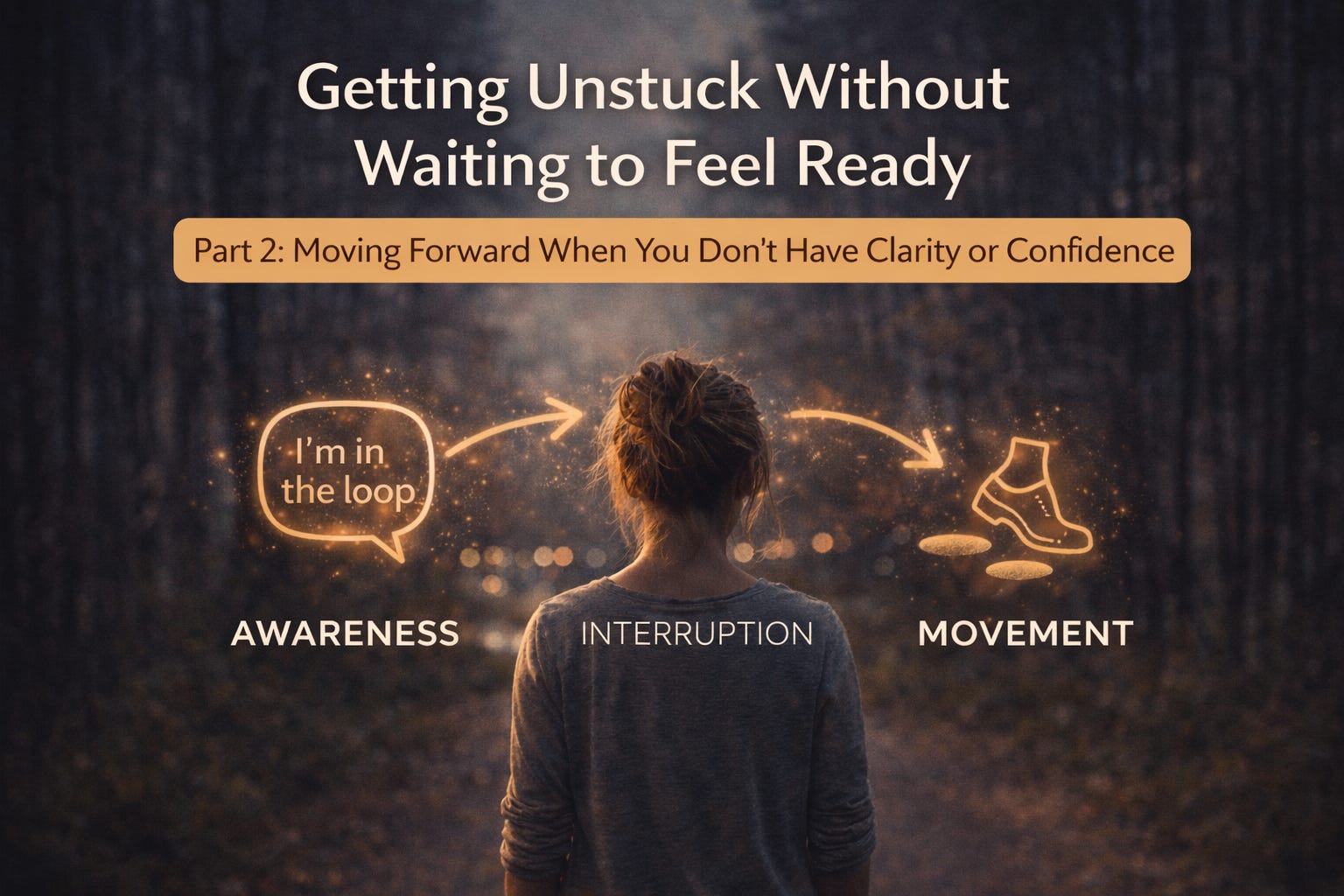
A Simple Framework: Awareness, Interruption, Movement
To make this practical without overcomplicating it, you can think of this as three stages:
Awareness → Interruption → Movement
Not something to get perfect, but something to come back to when you notice yourself stuck in that familiar pattern.
Because the shift doesn’t come from one big decision. It comes from changing how you respond inside the loop.
Step One: Awareness of the Loop (Without Judging It)
The first step is recognising when you’re in it.
Not analysing it in depth, and not criticising yourself for it, but simply noticing the pattern as it’s happening.
You might catch yourself going over the same decision again, or replaying the same thoughts without moving any closer to action. There’s often a feeling of mental activity without direction, like you’re doing something, but not actually getting anywhere.
When you notice that, pause for a moment and name it clearly.
“I’m in the loop again.”
That small moment of awareness creates separation. It stops the pattern from running completely on autopilot, and gives you a chance to respond differently.
Step Two: Interrupting the Pattern Gently
Once you’ve noticed the loop, the next step isn’t to solve it.
It’s to interrupt it.
This is where most people go back into thinking. They try to work it out, find the perfect answer, or push themselves to feel more certain. But that usually keeps the loop going.
Instead, the interruption needs to come from outside the pattern.
That might be something as simple as stepping away for a moment, changing your environment, or shifting your attention onto something physical your breathing, your surroundings, or even just standing up and moving.
The goal isn’t to escape the situation, but to break the continuous cycle of thought long enough to create space.
Even a short interruption changes the momentum.
Step Three: Choosing Movement Over Certainty
This is where the real shift happens.
After you’ve created that small amount of space, the next step is to move but not in the way you might expect.
You’re not looking for the perfect action.
You’re looking for the next available one.
Something small, clear, and doable without needing to resolve everything first.
Because the trap of feeling stuck is often the belief that you need clarity, confidence, or the right plan before you can act.
In reality, those things tend to come from movement, not before it.
So instead of asking, “What’s the best thing to do?”, try asking, “What’s the simplest step I can take from here?”
Then take it.
Even if it feels incomplete.
Even if it feels slightly uncomfortable.
That’s how the loop begins to loosen.
Let’s Work Through This Together
Think of something you’ve been stuck on recently.
Not something overwhelming, just something you’ve been circling without moving forward.
Now walk through it slowly.
First, recognise the pattern. Notice where your thinking keeps returning to the same point without resolution.
Then imagine interrupting it. Not by solving it, but by stepping out of that mental loop for a moment. A pause, a shift, a small break in the cycle.
And from that space, consider one small step you could take. Not the final decision, not the perfect move, just the next one.
As you do this, notice how it feels.
Not necessarily easier, but different.
Less like you’re waiting, and more like you’re moving.
When It Feels Uncomfortable to Move
This is important, because this is often where people stop.
Taking action without feeling ready can feel uncomfortable. There can be doubt, hesitation, or the sense that you’re not doing it “properly.”
That doesn’t mean you’re doing it wrong.
It means you’re stepping outside the pattern.
The discomfort isn’t a sign to stop. It’s often a sign that you’re doing something differently.
If you wait for that discomfort to disappear before you act, you’ll likely stay in the loop. But if you’re willing to move with it there, even slightly, it begins to lose its hold.
Over the Next 7 Days
Treat this as something to practise, not perfect.
When you notice yourself stuck, start with awareness. Recognise the loop without getting pulled further into it.
Then interrupt it, even briefly.
And where you can, choose one small step forward, without needing to have everything figured out.
You don’t need to apply this to everything.
Even once a day is enough to start shifting how you respond.
Closing Reflection
Feeling stuck can be frustrating, especially when it feels like you’re already trying.
But often, the shift isn’t about trying harder.
It’s about changing how you respond in the moments where you would usually stay in the loop.
When you move, even slightly, without waiting for certainty or confidence, something begins to change.
Not all at once.
But enough to remind you that you’re not as stuck as you feel.