
Breaking the Pattern Without Fighting Your Mind
Part 2: How to Change Repetitive Thinking in Real Time

From The Guided Ascent, a series within The Ascent Within
In the last issue, we explored why you can understand your thoughts, recognise your patterns, and still find yourself back in the same place. Not because you’re doing anything wrong, but because your mind is following something familiar.
Here, we’re going to go a level deeper.
Because once you see the pattern, the next question is usually the hardest one:
“How do I actually change it?”
And this is where most people get stuck again, because the instinct is to fight the thoughts, to try and stop them, or to replace them with something more positive. But if the pattern is being driven by something underneath, that approach often keeps you caught in the same loop.
So instead of trying to control your thoughts directly, we’re going to work with the pattern in a different way.
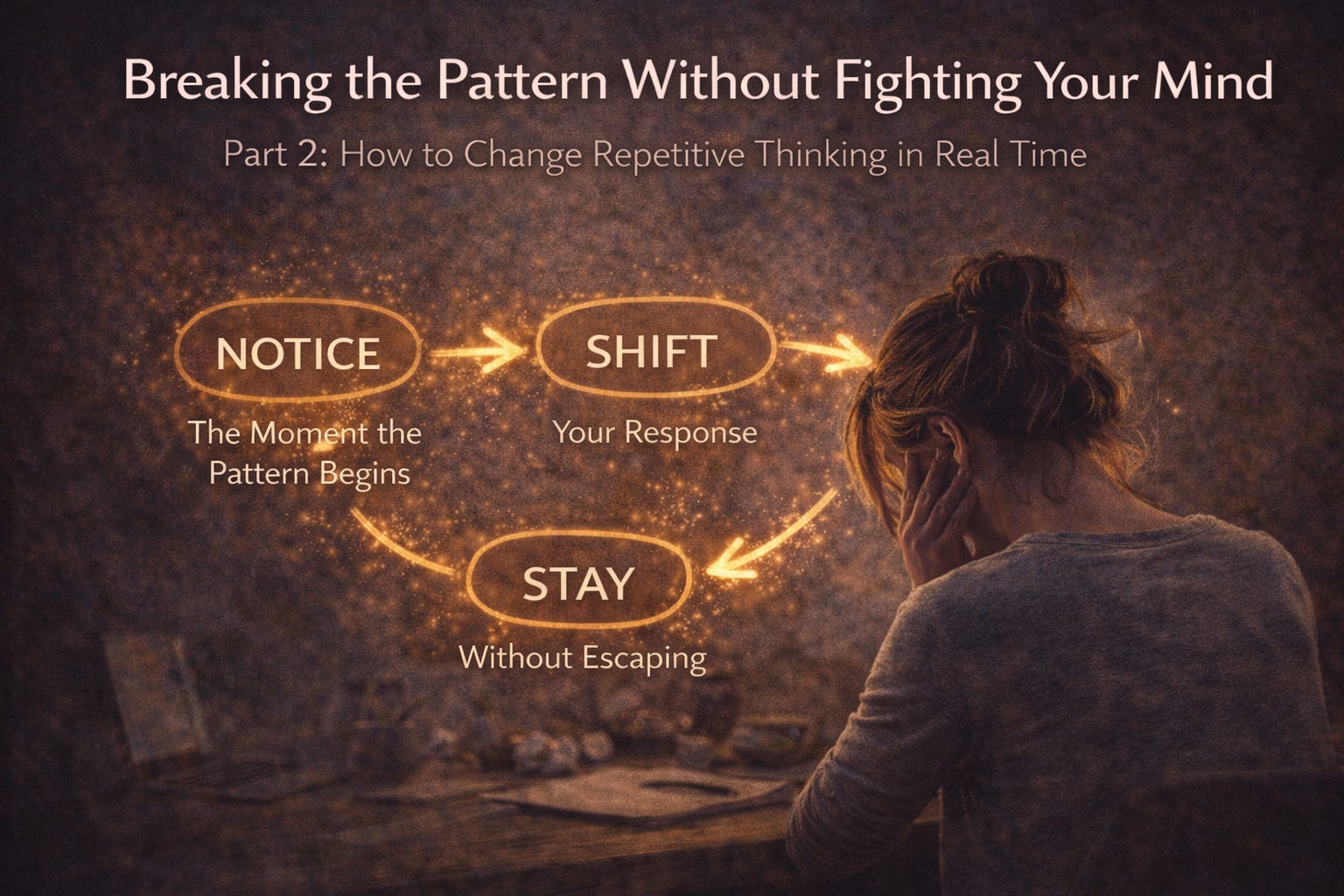
A Simple Framework: Notice, Shift, Stay
To keep this practical without overcomplicating it, you can think of this as three stages:
Notice → Shift → Stay
Not as something to perfect, but as something to return to when you feel yourself being pulled into familiar thinking.
Because the goal isn’t to stop the thoughts from appearing.
It’s to stop them from automatically taking over.
Step One: Notice the Moment the Pattern Begins
Most patterns feel strongest when you’re already in them.
Your thoughts are active, your attention is pulled in, and it feels like something you need to engage with.
But if you slow this down, there’s usually a moment right at the beginning where something shifts.
A feeling shows up. A sense of discomfort, uncertainty, or tension. And almost immediately, your mind starts responding in the way it always has.
The first step is learning to notice that moment.
Not perfectly, and not every time, but often enough that you begin to recognise the starting point rather than just the full loop.
You might find yourself thinking, “This is the point where I usually get pulled in.”
And that awareness gives you a small window to respond differently.
Step Two: Shift Your Response (Not the Thought)
This is where the approach changes.
Instead of trying to challenge or replace the thought, you shift your response to the feeling that triggered it.
That might mean pausing instead of engaging. Taking a breath, stepping back slightly, or simply deciding not to follow the thought further in that moment.
You’re not trying to make the thought disappear.
You’re choosing not to build on it.
This can feel subtle, but it’s important. Because every time you respond differently, you weaken the automatic nature of the pattern.
Step Three: Stay With the Discomfort Without Escaping It
This is often the most difficult part.
When you don’t follow the usual pattern, the feeling that triggered it doesn’t immediately go away. It can sit there for a while, without being resolved in the way your mind is used to.
And that’s where the urge to go back into thinking can become strong again.
So the final step is to stay with that feeling, just for a moment longer than you normally would.
Not forcing it.
Not analysing it.
Just allowing it to be there without needing to escape it.
Over time, this is what starts to change the pattern at its core.
Because you’re showing your system that the feeling doesn’t need to be solved through repetitive thinking.
Let’s Work Through This Together
Think of a recent moment where you found yourself caught in a familiar loop.
Now imagine going back into that moment, but this time noticing the very start of it. The feeling that appeared just before the thoughts took over.
Instead of following it, you pause.
You allow the feeling to be there, even if it’s slightly uncomfortable, and you choose not to build on the thoughts that usually follow.
You stay with it, just for a little longer.
As you picture that, notice what changes.
The thoughts may still appear, but they don’t have the same pull. There’s a bit more space, a bit more choice in how you respond.
When It Feels Like You’re Being Pulled Back In
There will be times when this feels difficult.
Moments where the pattern feels strong, and you find yourself back in it before you’ve even realised. Times where the thoughts feel too important to step away from.
That doesn’t mean you’ve gone backwards.
It just means the pattern is still familiar.
When that happens, come back to the first step.
Notice it, even if it’s halfway through.
Because even that awareness begins to interrupt the automatic response.
Over the Next 7 Days
Rather than trying to change everything at once, treat this as something to practise lightly.
When you notice a familiar thought pattern starting, see if you can pause before fully engaging with it.
Shift your response, even slightly.
And where you can, stay with the feeling underneath it for a moment, without trying to resolve it immediately.
You don’t need to do this perfectly.
Even small moments of doing it differently begin to change how the pattern operates.
Closing Reflection
You don’t need to fight your mind to change it.
Most patterns aren’t broken through force.
They change when you respond differently to what’s underneath them.
When you notice the moment, shift your response, and stay with the feeling instead of escaping it, something begins to loosen.
Not all at once.
But enough to create space.
And in that space, you’re no longer just repeating the pattern.
You’re starting to change it.
Thanks for reading,
Ian
Rise with clarity and confidence.
Looking to build more calm, clarity, control, and confidence in your life?
You can explore more through The 4C’s Method by Ian Callister